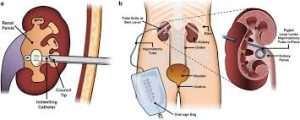
Definition: A thin, flexible tube (stent) placed in the ureter (the tube connecting the kidney to the bladder) to ensure urine drainage.
Procedure Steps:
1. Anesthesia: Usually under sedation or general anesthesia.
2. Access: A cystoscope is passed through the urethra into the bladder.
3. Visualization: The openings of the ureters (ureteral orifices) are located.
4. Placement: A guidewire is passed up the ureter into the kidney. The stent is then threaded over the wire into position.
5. Confirmation: X-ray (fluoroscopy) is used to confirm correct placement. The stent has a coil at both ends to hold it in place in the kidney and the bladder.
Purpose / Benefits:
• Purpose: To relieve or prevent obstruction of the kidney caused by stones, tumors, or strictures.
• Benefits:
o Relieves pain and preserves kidney function by allowing urine to flow.
o Can be temporary (e.g., until a stone is treated) or long-term (for chronic obstructions).