
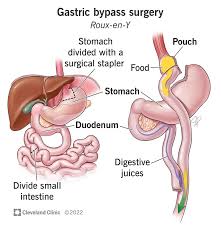
Definition: The classic and most widely studied gastric bypass procedure. It involves creating a small stomach pouch and rerouting the small intestine into a Y-shaped configuration.
Procedure Steps:
- Anesthesia: General anesthesia.
- Access: Performed laparoscopically.
- Creating the Pouch: A small (about 30 ml) stomach pouch is created, completely separated from the rest of the stomach.
- Rerouting (Roux-en-Y):
- The small intestine is divided.
- The lower end of the divided intestine (the “Roux limb”) is connected to the new stomach pouch.
- The upper section of the intestine (carrying bile and pancreatic juices) is reconnected to the Roux limb further down, creating the “Y” shape.
- Closing: The incisions are closed.
Purpose / Benefits:
- Purpose: Combines restrictive and malabsorptive mechanisms for weight loss. It also causes favorable hormonal changes.
- Benefits:
- Gold standard for weight loss surgery with excellent long-term results.
- Very effective for resolving type 2 diabetes and acid reflux.
- The separated pouch prevents bile from flowing into the esophagus.